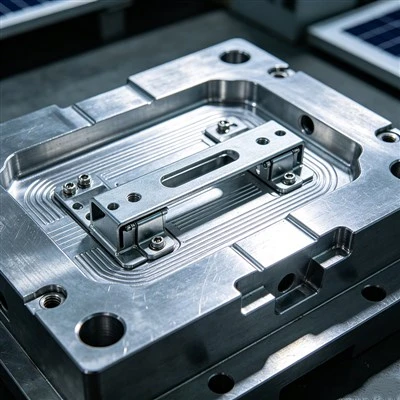


Our Magnesium Alloy Motorcycle Parts Die Casting Mold is developed for high-pressure die casting of motorcycle structural and housing components. We manufacture custom tooling for AZ91D, AM60B, and AS41B magnesium alloys, with mold configurations matched to component drawings and production machine requirements.
Technical Specifications
| Parameter | Specification |
|---|---|
| Mold Application | Motorcycle body frames and structural components |
| Casting Alloys | AZ91D, AM60B, AS41B |
| Compatible Die Casting Machine | 280T–1500T |
| Mold Steel Hardness | 44–48 HRC |
| Expected Mold Service Life | Over 150,000 shots, subject to maintenance and operating conditions |
Motorcycle Components
Motorcycle Frames: Structural frame components used to support the motorcycle body and connect major assemblies.
Engine Housings: Protective housings for engine components, providing space for internal mechanisms and mounting points.
Transmission Cases: Enclosures for transmission gears and related drivetrain components.
Clutch Covers: Covers that protect the clutch assembly and provide an enclosed mounting structure.
Engine Covers: Protective covers for engine-side components, helping shield internal parts from external impact and debris.
Structural Brackets: Load-bearing connecting parts used to support motorcycle assemblies and attached components.
Mounting Brackets: Components used to secure engines, body parts, and other motorcycle assemblies to the main structure.
Mold Design
Each motorcycle component has different structural requirements. We develop the mold layout based on the part drawing, including the cavity, feeding system, cooling channels, and ejection structure.
Mold Parting
The parting position is selected according to the component shape, keeping the mold opening and casting removal practical.
Metal Feeding
The runner and gate positions are arranged to direct molten magnesium into the cavity and fill thin sections and complex areas.
Air Venting
Venting channels are placed at suitable positions to allow trapped air to escape during filling.
Mold Cooling
Cooling channels are positioned around areas where heat tends to accumulate, helping maintain a more balanced mold temperature.
Part Ejection
Ejector pins are positioned according to the casting structure to avoid interference with critical surfaces and mounting features.


Functional Features
Precision-Machined Cavities: CNC-machined cavity and core surfaces follow the specified part geometry and critical dimensions.
Replaceable Mold Inserts: Separate inserts allow selected mold sections to be replaced without remanufacturing the entire mold.
Guided Mold Movement: Guide pillars and bushings maintain alignment between the cavity and core during repeated mold operation.
Tool Steel & Heat Treatment
We select mold steel according to the tooling structure and expected production conditions. Heat treatment is applied to achieve the specified working hardness and support repeated casting cycles.
Steel Hardness: The specified mold steel hardness is 44–48 HRC.
Heat Treatment: Heat-treated mold components provide the required hardness and resistance to wear during repeated production.
Machine Compatibility
We match the mold dimensions and installation structure to the customer's die casting machine before tooling manufacture.
Clamping Force: Our mold projects cover die casting machines in the 280T–1500T range.
Installation Dimensions: Mold thickness, overall dimensions, and mounting arrangements are checked against the machine's platen and installation specifications.
Machine Interface: Ejection arrangements and other machine-related connections are considered during mold design to ensure compatibility with the selected equipment.
After-Sales Service
We provide technical support after mold delivery to assist with production setup and ongoing tooling maintenance.
Mold Installation & Setup: Assistance with mold installation and initial machine setup.
Trial Run Support: Technical assistance during mold testing and troubleshooting of initial casting issues.
Maintenance Guidance: Instructions for mold cleaning, lubrication, and inspection of moving parts and working surfaces.
Mold Repair & Spare Parts: Support for mold repairs and replacement of worn inserts and tooling components.
Packaging & Delivery
Lead Time: 35–50 days, depending on mold complexity and customization requirements.
Packaging: Anti-rust treatment, protective wrapping, and export-standard wooden crates.
Shipping: Sea freight, air freight, or express delivery according to mold size and customer requirements.
Delivery Inspection: Mold condition and packaging are checked before dispatch.
FAQ
What information is needed to get a quotation for a magnesium alloy motorcycle parts die casting mold?
Please provide the 3D part model, 2D drawings, annual production volume, casting requirements, and project specifications. These details help us evaluate tooling complexity and prepare a project-based quotation.
Can you manufacture a magnesium alloy motorcycle mold from an existing production part?
Yes. We can evaluate an existing casting sample or reverse-engineered part data to develop the corresponding mold design, subject to the availability of sufficient dimensional information.
Can the mold design be modified after the first trial casting?
Yes. We can review trial casting results and make necessary tooling adjustments to address dimensional deviations, surface issues, or assembly-related requirements before final approval.
How do you verify that motorcycle die-cast parts meet the required dimensions?
We evaluate critical dimensions against the approved engineering drawings and inspection criteria. Dimensional inspection records and sample measurements can be used for customer review and approval.
Can one die casting mold produce different motorcycle part models?
A mold is generally designed for a specific component geometry. When several models share similar structures, we can evaluate interchangeable inserts or separate cavity configurations to accommodate different part designs.
Can you manufacture spare mold components for future replacement?
Yes. Replaceable inserts and other designated tooling components can be manufactured as spare parts to support mold repair and reduce downtime during production.
Hot Tags: magnesium alloy motorcycle parts die casting mold, China magnesium alloy motorcycle parts die casting mold manufacturers, suppliers, factory, magnesium alloy die casting mold, Magnesium Alloy Motorcycle Parts Die Casting Mold, Magnesium Motorbike Parts Mold, Magnesium Motorbike Tooling, Magnesium Motorcycle Component Mold, Motorcycle Magnesium Die Cast Mold