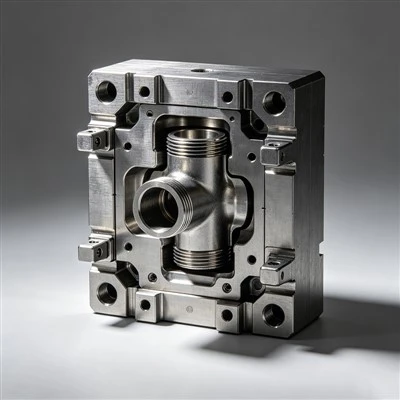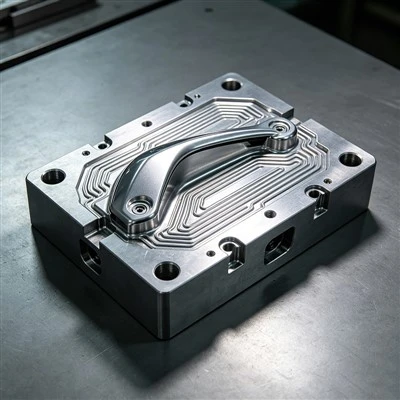


Our Motorcycle Engine Cover Mold is a custom aluminum alloy high-pressure die casting mold designed for mass production of motorcycle engine casings, crankcase covers, cylinder covers, and protective engine housings. Manufactured with H13 hot-work tool steel, we develop each mold according to your component drawings, dimensional specifications, and production requirements.
Technical Specifications
| Parameter | Specification |
|---|---|
| Product Name | Motorcycle Engine Cover Mold |
| Mold Type | High Pressure Die Casting Mold |
| Casting Material | Aluminum Alloy |
| Mold Steel | H13 Hot-Work Tool Steel |
| Steel Hardness | HRC50–54 |
| Heat Treatment | Vacuum Quenching & Tempering |
| Cavity Machining | 5-Axis CNC & EDM |
| Gating System | Graded Pouring System |
| Cooling System | Circulating Water Channels |
High Wear Resistance
Forged H13 Steel
We use forged H13 hot-work steel for strong resistance to heat and molten aluminum erosion.
Vacuum Heat Treatment
We apply vacuum quenching and tempering to improve hardness and thermal fatigue resistance.
HRC50–54 Hardness
We control mold steel hardness within HRC50–54 to resist cavity wear during repeated casting.
Stable Mold Temperature
Circulating Water Cooling
We integrate cooling water channels into the mold structure to remove accumulated heat during repeated casting cycles.
Balanced Heat Distribution
We arrange cooling channels according to cavity geometry to reduce temperature differences between different mold areas, supporting more uniform thermal conditions.
Reduced Thermal Stress
Controlled heat dissipation helps limit localized overheating and excessive thermal fluctuations, reducing thermal stress on the mold during production.
Reliable Mold Operation
Stable Clamping
We use a thickened mold frame to support the clamping load during high-pressure die casting, helping prevent frame deformation and maintain mold closure.
Accurate Parting Alignment
We fit precision positioning components between the moving and fixed mold halves to control their relative position, helping prevent cavity offset and mismatched casting edges.
Smooth Part Release
We position ejector pins around the engine cover's structural features to apply force at suitable contact points, helping release the casting without localized stress or damage.
Customization Options
| Customization Item | Available Options |
|---|---|
| Engine Cover Design | Left / right engine covers, clutch covers, crankcase covers, and other cover designs |
| Casting Material | Aluminum alloy grades according to casting requirements |
| Mold Cavity | Single-cavity or multi-cavity layout |
| Parting Line | Customized parting line based on component geometry |
| Gating System | Gate position, runner layout, and ingate dimensions |
| Cooling System | Cooling channel position and layout |
| Venting System | Exhaust slot position and venting layout |
| Ejection System | Ejector pin positions and ejection layout |
| Machining Allowance | Reserved machining areas for sealing surfaces, mounting holes, and other functional features |
| Mold Identification | Customer logo, part number, and mold identification markings |
Quality Control
Trial Casting Inspection
We run trial shots using the specified aluminum alloy and die-casting parameters. We examine sample castings for incomplete filling, cold shuts, flash, and visible surface defects to identify problems in the gating, venting, and mold-closing conditions.
Dimensional Measurement
We use CMM equipment and precision measuring tools to check critical dimensions, including mounting holes, sealing surfaces, bolt positions, and overall component geometry against the approved drawings.
Internal Defect Testing
We use X-ray inspection on selected trial castings to identify internal porosity and shrinkage defects that cannot be confirmed through visual inspection, particularly around thick sections and functional areas.
Mold Operation Verification
We inspect mold opening and closing, parting-line fit, ejector movement, and cooling-water circulation during trial operation. Any identified interference, leakage, or ejection issue is corrected before final acceptance.
Final Sample Approval
We compare corrected trial samples with the customer's drawings and agreed acceptance criteria. Final mold delivery proceeds after the required dimensional and casting-quality checks are completed.
FAQ
How long does it take to manufacture a motorcycle engine cover mold?Typically 45–60 working days after drawing approval and order confirmation, including design, machining, assembly, and T1 trials.
What information is needed for a mold quotation?Provide 3D files (STEP, IGES, or X_T), 2D drawings, alloy specifications, production volume, and die casting machine details. Quotations are typically provided within 2 working days.
Can the mold fit our existing die casting machine?Yes. We customize mold dimensions and structure according to machine clamping force, platen size, tie-bar spacing, opening stroke, and injection parameters.
Who owns the custom motorcycle engine cover mold?The customer retains mold ownership after full payment. Custom tooling is developed for the customer's specified component design.
Can you supply mold replacement parts?Yes. We supply ejector pins, guide pins, guide bushings, and other accessories. Standard parts typically take 3–7 working days to prepare.
How do you package molds for export?We use export-grade wooden crates with internal fixation and moisture protection. Sea and air freight options are available.
What is the mold warranty period?We provide a 12-month warranty against manufacturing defects under normal operating conditions, with technical troubleshooting and repair support.
Do you provide support after mold installation?Yes. We offer remote assistance with installation, production setup, and troubleshooting based on operating videos and casting samples.
Hot Tags: motorcycle engine cover mold, China motorcycle engine cover mold manufacturers, suppliers, factory, Motorbike Engine Housing Tooling, Motorbike Instrument Shell Mold, Motorcycle Gauge Housing Tooling, Motorcycle Pedal Casting Mold, Motorcycle Rear View Mirror Mold, Motorcycle Rim Hub Mold