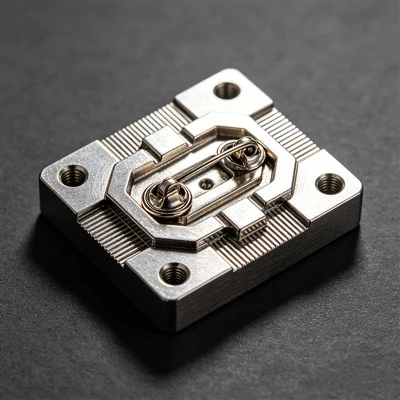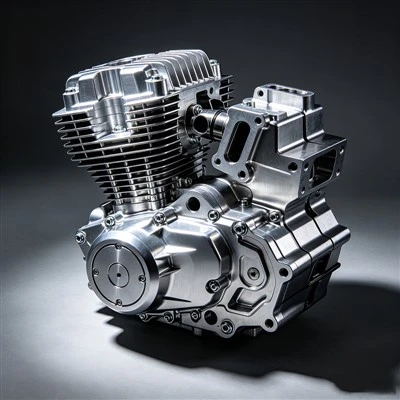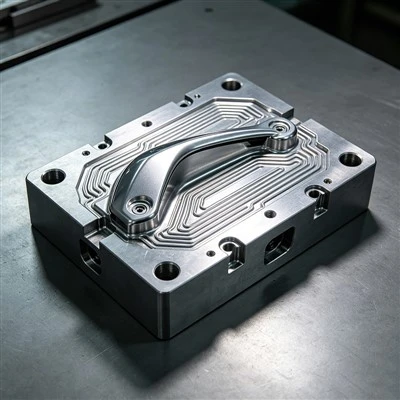


Our Motorcycle Instrument Housing Mold is a custom aluminum alloy die casting mold designed for manufacturing motorcycle meter housings, instrument bottom brackets, and waterproof alloy enclosures. Built with forged H13 hot-work tool steel, it combines precision cavity machining, optimized cooling, and multi-directional venting to support consistent casting quality and reliable component assembly for fuel-powered motorcycles, electric motorcycles, and scooters.

Motorcycle instrument housing mold

Mold cavity and cooling channel details

Instrument housing cavity structure
Technical Specifications
| Parameter | Specification |
|---|---|
| Mold Type | Aluminum Alloy Die Casting Mold |
| Application | Motorcycle Instrument Housing |
| Mold Steel | Forged H13 Hot-Work Tool Steel |
| Heat Treatment | Vacuum Quenching |
| Steel Hardness | HRC 48–52 |
| Machining Process | Five-Axis CNC Machining |
| Cavity Finishing | Mirror EDM Polishing |
| Cooling System | Circulating Cooling Channels |
| Venting System | Multi-Directional Exhaust Grooves |
Motorcycle Instrument Housing Mold Design
Housing Contours
The cavity reproduces curved surfaces, recessed areas, and external profiles according to approved drawings.
Mounting Features
Screw bosses, fixing holes, and positioning points are incorporated into the cavity to meet assembly requirements.
Wall Thickness Transitions
We account for wall thickness variations and rib connections to reduce uneven filling and localized shrinkage.
Parting Line Design
We position parting lines according to the housing geometry to facilitate mold opening and casting removal while minimizing flash.
H13 Steel for Repeated Die Casting
Forged H13 Construction
We use forged H13 hot-work tool steel for its resistance to thermal fatigue, high-temperature exposure, and aluminum melt erosion during repeated die casting cycles.
Vacuum Quenching Treatment
Vacuum quenching provides the H13 working surfaces with the hardness and wear resistance required for repeated die casting cycles.
Cooling, Venting & Casting Quality
Circulating Cooling Channels
We optimize cooling channel layouts according to cavity geometry to improve heat distribution and support consistent casting cycles.
Multi-Directional Exhaust Grooves
We position exhaust grooves to facilitate air evacuation during mold filling, helping reduce gas porosity, incomplete filling, and surface defects.
Reinforced Mold Frame
Our reinforced mold frame resists deformation under repeated thermal and mechanical loading, maintaining mold alignment during production.
Custom Mold Configurations
| Configuration | Available Options |
|---|---|
| Mold Cavity | Single-cavity / Multi-cavity |
| Mold Size | Customized length, width, and height |
| Cavity Design | Different housing shapes, dimensions, and structural details |
| Parting Line | Customized parting surface and mold opening direction |
| Gating and Runner System | Customized gating and runner layout according to the casting design |
| Overflow and Venting | Customized overflow positions and venting layout |
| Mold Inserts | Replaceable inserts for applicable design variations |
| Mold Base | Customized according to die casting machine requirements |
Quality Control
Mold Dimension Inspection
CMM, micrometers, and precision gauges are used to check cavity dimensions, parting surfaces, and critical mold features. Inspection results are compared with approved mold drawings.
H13 Steel Hardness Testing
A Rockwell hardness tester verifies the heat-treated H13 steel hardness against the specified HRC 48–52 range.
Cavity Surface Inspection
Visual inspection checks EDM surfaces, cavity polishing, and potential machining marks to ensure the required surface finish.
Trial Casting Inspection
Trial samples are checked for incomplete filling, flash, shrinkage marks, and surface defects. Critical mounting dimensions are measured against the component drawings.
Internal Defect Inspection
X-ray inspection can be arranged for trial castings when internal porosity evaluation is required by the project.
Final Mold Verification
We check mold opening and closing, part ejection, and alignment before shipment to confirm normal mold operation.
Supply Information
| Parameter | Details |
|---|---|
| MOQ | 1 Set |
| Lead Time | 30–45 Working Days |
| Customization | OEM / ODM |
| Design Format | 2D Drawings / 3D CAD Files |
| Mold Material | H13 Hot-Work Tool Steel |
| Sample | T1 Trial Samples Available |
| Quality Inspection | 100% Mold Inspection Before Shipment |
| Packaging | Export-Grade Wooden Case |
| Payment Terms | 50% Deposit, 50% Before Shipment |
| Shipping Methods | Sea Freight / Air Freight |
Frequently Asked Questions
Can You Help Us Install the Mold on Our Die Casting Machine?
Yes. We can provide mold installation guidance, including mold positioning, clamping requirements, cooling connections, and operating precautions to support proper installation on the customer's die casting machine.
Do You Provide Technical Support During Initial Production?
Yes. We provide technical assistance during production start-up, helping customers address mold operation, filling conditions, ejection issues, and other tooling-related adjustments.
What Spare Parts Should We Keep for Motorcycle Instrument Housing Molds?
We recommend keeping commonly replaceable components such as ejector pins, return pins, guide pins, and applicable mold inserts to reduce production interruptions caused by component wear.
Can You Supply Replacement Mold Components After Delivery?
Yes. We can manufacture replacement mold components according to the original tooling drawings or supplied specifications, helping customers maintain the mold without replacing the complete tool.
How Often Should a Motorcycle Instrument Housing Die Casting Mold Be Maintained?
Maintenance frequency depends on production volume, casting conditions, and mold wear. We recommend regular inspection of cavity surfaces, parting surfaces, ejector components, cooling channels, and venting areas.
What Should We Do If Casting Flash Appears During Production?
Casting flash may result from parting surface wear, insufficient clamping force, mold misalignment, or excessive injection pressure. We can assist in identifying the tooling-related cause and recommend appropriate mold adjustments.
Do You Provide Mold Repair and Refurbishment Services After Long-Term Production?
Yes. We provide mold repair and refurbishment support, including cavity polishing, worn component replacement, and localized mold modification to extend tooling service life.
Request a Motorcycle Instrument Housing Mold Quote
Send us your 2D drawings or 3D CAD files to discuss mold specifications, tooling configurations, and project requirements.
Send InquiryHot Tags: motorcycle instrument housing mold, China motorcycle instrument housing mold manufacturers, suppliers, factory, Motorbike Engine Housing Tooling, Motorbike Instrument Shell Mold, Motorbike Wheel Component Mold, Motorcycle Engine Cover Mold, Motorcycle Handle Control Mold, Motorcycle Power Unit Cover Mold