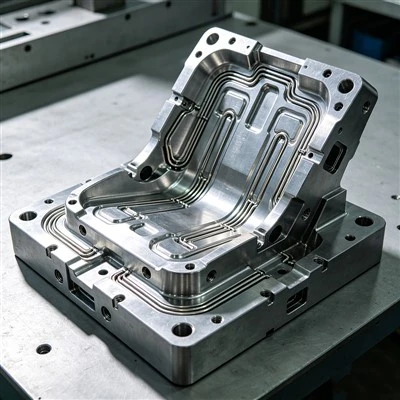


Our Car Air Outlet Mold is a customized aluminum alloy die casting mold developed for manufacturing automotive interior air outlet components. Designed for both new energy vehicles and conventional fuel vehicles, it combines hardened H13 tool steel, precision cavity machining, and optimized cooling and pouring systems to support dimensional consistency and efficient batch production.
Technical Specifications
| Parameter | Specification |
|---|---|
| Mold Type | Aluminum Alloy Die Casting Mold |
| Application | Automotive Air Outlet Components |
| Applicable Vehicles | New Energy & Fuel Vehicles |
| Mold Steel | H13 Hot-Work Tool Steel |
| Heat Treatment | Integral Vacuum Quenching |
| Mold Hardness | HRC 48–52 |
| Cavity Machining | Five-Axis CNC |
| Surface Machining | EDM Mirror Machining |
| Runner System | Optimized Pouring and Cooling System |
Mold Material and Heat Treatment
We use H13 hot-work tool steel for the mold cavity and core components. Its heat resistance and wear resistance make it suitable for repeated exposure to molten aluminum during high-pressure die casting.
Integral vacuum quenching heat treatment improves the mold's resistance to thermal deformation and wear.
The treated mold steel reaches HRC 48–52, providing a suitable balance of hardness and resistance to repeated thermal loading.
Cavity Machining
The cavity machining process directly affects the dimensional accuracy and surface quality of finished aluminum air outlet components.
Handles complex cavity geometries and detailed forming surfaces with accurate machining control.
Produces refined cavity surfaces and detailed structural features, supporting the required appearance of automotive interior components.
Controls the geometry of buckles, grille structures, and positioning grooves to meet specified component drawings.
Pouring and Cooling Performance
Optimized pouring runner layouts distribute molten aluminum more evenly throughout the cavity, reducing incomplete filling and casting defects.
Strategically arranged cooling channels accelerate heat removal and promote uniform solidification, helping shorten casting cycles.
Coordinated pouring and cooling parameters reduce temperature variations and solidification inconsistencies, improving dimensional stability across production batches.
Customization Process
We review your 2D drawings, 3D CAD files, aluminum alloy specifications, component dimensions, and production requirements to define the mold development scope.
Our engineers develop the mold structure, including cavity layout, parting lines, pouring runners, cooling channels, and ejection mechanisms according to the component geometry and die casting machine requirements.
We select suitable H13 tool steel and carry out CNC machining, five-axis machining, EDM, and other precision manufacturing operations.
We perform vacuum quenching to achieve the specified HRC 48–52 hardness, followed by mold fitting, assembly, and mechanical inspection.
We conduct trial production and evaluate casting dimensions, surface quality, and forming results against the agreed requirements.
We make necessary adjustments based on trial results, complete final inspections, and prepare the mold for shipment.
Quality Control
We apply inspection procedures throughout mold manufacturing to verify material properties, machining accuracy, structural fit, and casting performance.
We use a Rockwell hardness tester to inspect heat-treated H13 steel. The specified hardness is HRC 48–52, confirming compliance with the required heat treatment standard.
We use coordinate measuring machines (CMM) and precision measuring instruments to check critical dimensions against CAD data and engineering drawings, identifying dimensional deviations before assembly.
We inspect machined cavity surfaces using surface roughness measuring instruments and visual examination to verify surface finish and identify machining marks or defects.
We check parting surfaces, guide pillars, guide bushes, sliders, and ejector mechanisms through fitting and opening-and-closing tests to identify interference, misalignment, or abnormal movement.
We evaluate trial-cast samples using dimensional measurement and visual inspection, checking for porosity, shrinkage, cold shuts, flash, and other casting defects.
We review inspection records, trial sample results, and mold operating conditions against agreed technical requirements before shipment.
Supply Information
| Item | Supply Details |
|---|---|
| Product | Aluminum Car Air Outlet Die Casting Mold |
| MOQ | 1 Set |
| Mold Material | H13 Hot-Work Tool Steel |
| Mold Hardness | HRC 48–52 |
| Cavity Configuration | Single or Multi-Cavity |
| Sample | Trial Casting Samples Available |
| Lead Time | To Be Confirmed Based on Mold Complexity |
| Packaging | Export-Standard Wooden Case |
| Delivery | Sea Freight / Air Freight |
| Payment Terms | Negotiable |
| After-Sales Service | Mold Repair and Modification Support |
Frequently Asked Questions
Can the Car Air Outlet Die Casting Mold be designed for our existing die casting machine?
Yes. We design the mold according to your machine's clamping force, platen dimensions, tie-bar spacing, injection capacity, and mold installation requirements to ensure equipment compatibility.
Which aluminum alloys can be used for car air outlet die casting?
Common automotive aluminum die casting alloys include ADC12, A380, and AlSi9Cu3. We select the mold design and casting parameters according to the specified alloy and component requirements.
Can you manufacture molds for complex car air outlet geometries?
Yes. We develop customized cavity and core structures for complex shapes, integrated mounting features, deep cavities, and other geometry requirements based on your component drawings.
Can the mold accommodate future changes to the air outlet design?
Yes. Where the component structure permits, we can incorporate replaceable inserts and modular mold components to facilitate localized modifications without rebuilding the entire mold.
Who owns the mold after the project is completed?
Mold ownership and intellectual property arrangements can be defined in the purchase agreement, including ownership transfer, storage, maintenance responsibilities, and restrictions on third-party use.
Can you manufacture replacement molds for an existing car air outlet component?
Yes. We can develop replacement tooling based on existing mold samples, component drawings, or 3D CAD data. This supports tooling replacement when existing molds are worn, damaged, or no longer meet production requirements.
Hot Tags: car air outlet mold, China car air outlet mold manufacturers, suppliers, factory, automotive parts die casting mold, Car Air Outlet Mold, Car Interior Bracket Mold, Car Logo Mold, Car Motor Parts Mold, Vehicle Instrument Support Tooling