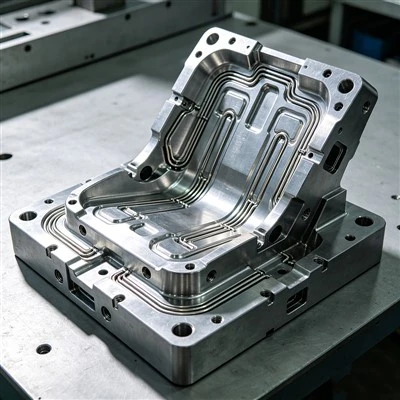


Our Car Instrument Bracket Mold is an H13 steel aluminum die casting mold developed for manufacturing automotive instrument panel support and fixing brackets. Designed for fuel-powered and new energy passenger vehicles, it supports precision casting of mounting holes, reinforcing ribs, and assembly features for consistent component production.
Technical Specifications
| Parameter | Specification |
|---|---|
| Mold Type | Aluminum Alloy Die Casting Mold |
| Mold Application | Automotive Instrument Brackets |
| Mold Steel | H13 Hot-Work Tool Steel |
| Heat Treatment | Vacuum Heat Treatment |
| Mold Hardness | HRC 48–52 |
| Cavity Machining | Five-Axis CNC Machining |
| EDM Process | Mirror EDM |
| Cooling System | Circulating Water Channels |
| Gating System | Optimized Pouring Port Design |
Mold Design
We design the mold structure according to the bracket geometry and aluminum die casting requirements.
Cavity & Core: Configured to form mounting holes, reinforcing ribs, and complex bracket profiles.
Parting Line: Positioned to facilitate mold opening, casting removal, and flash control.
Gating System: Optimized gate and runner layouts promote balanced molten aluminum filling.
Venting & Overflow: Strategically positioned vents and overflow pockets help discharge trapped air and excess molten metal.
Cooling Channels: Circulating water channels are arranged to maintain balanced mold temperatures.
Ejection System: Ejector pins are positioned to ensure smooth casting release and minimize deformation.
Key Features
High Thermal Resistance: H13 hot-work steel undergoes vacuum heat treatment to HRC 48–52, improving resistance to thermal fatigue and deformation during repeated aluminum die casting cycles.
High Wear Resistance: Heat-treated H13 steel provides a hardened cavity surface that resists wear under repeated production, helping maintain mold integrity and service life.
Precision Cavity Machining: Five-axis CNC machining processes complex cavity geometries and mounting features, ensuring accurate mold dimensions and component fit.
Fine Surface Finish: Mirror EDM finishing produces smooth cavity surfaces, reducing surface irregularities and supporting consistent casting quality.
Customization Options
We provide customized Car Instrument Bracket Molds based on component drawings, aluminum alloy requirements, and production specifications.
| Customization Item | Available Options |
|---|---|
| Mold Design | Custom 2D drawings, 3D CAD models, or sample-based development |
| Mold Size | Customized length, width, height, and overall mold dimensions |
| Cavity Configuration | Single-cavity or multi-cavity design |
| Mold Steel | H13 and other suitable hot-work tool steels |
| Aluminum Alloy | ADC12, A380, A360, or other specified alloys |
| Gating System | Customized gate positions, runner layout, and pouring configuration |
| Cooling System | Customized cooling channel layout and water connections |
| Ejection System | Ejector pin positions and ejection mechanism configuration |
| Die Casting Machine Compatibility | Customized mold dimensions and mounting configuration according to machine specifications |
| Mold Modifications | Cavity, core, and structural modifications based on design changes |
Quality Control
We inspect mold materials, machining accuracy, assembly conditions, and trial casting results to verify tooling quality before delivery.
Steel Hardness Verification: H13 mold steel is tested using a Rockwell hardness tester to confirm the specified HRC 48–52 hardness range.
Dimensional Accuracy Inspection: CMM measurement checks cavity dimensions, core positions, and critical geometric features against approved engineering drawings.
Cavity Surface Inspection: Surface roughness measurement and visual inspection identify machining marks, irregularities, and potential surface defects.
Mold Assembly Inspection: We check parting alignment, slider movement, and ejector operation to verify proper mechanical coordination.
Cooling Channel Testing: Pressure and leakage tests check cooling circuit connections and identify potential leakage.
Trial Casting Validation: Die casting trials evaluate aluminum filling, flash formation, surface defects, and component consistency.
Sample Dimensional Verification: Trial castings are measured against approved drawings to verify critical dimensions and assembly features.
Inspection Records: Relevant inspection results and trial sample measurement records are provided for customer review.
After-Sales Support
Production Validation: We provide trial samples for evaluating the mold's casting performance before final acceptance.
Mold Maintenance: We provide after-sales maintenance support to help customers address tooling wear and production-related issues.
Customization Support: We support subsequent mold size and structural modifications when component or production requirements change.
Frequently Asked Questions
What information is needed to get a quotation for a Car Instrument Bracket Mold?
Please provide 3D CAD files, 2D engineering drawings, annual production volume, aluminum alloy grade, and die casting machine specifications. These details help us evaluate tooling complexity and project requirements.
How long does it take to manufacture a custom Car Instrument Bracket Mold?
The lead time depends on mold complexity, cavity configuration, machining requirements, and project specifications. We confirm the production schedule after reviewing the drawings and finalizing the tooling design.
Can the mold be installed on our existing aluminum die casting machine?
Yes. We evaluate machine specifications, including clamping force, platen dimensions, tie-bar spacing, mold opening stroke, and injection requirements, to determine tooling compatibility.
What is included in the mold delivery package?
The delivery package can include the completed mold, approved trial samples, mold drawings, and relevant inspection documentation according to the project agreement.
Can you manufacture replacement inserts and spare mold components?
Yes. We can manufacture replacement cavity inserts, core components, ejector pins, and other tooling parts according to the original mold drawings and specifications.
Who owns the mold after the customer pays for custom tooling?
Mold ownership, intellectual property rights, and tooling storage arrangements are defined in the purchase agreement. We can establish project-specific terms before production begins.
Hot Tags: car instrument bracket mold, China car instrument bracket mold manufacturers, suppliers, factory, Auto Emblem Casting Mold, Automotive Air Outlet Tooling, automotive parts die casting mold, Automotive Seat Hardware Mold, Car Instrument Bracket Mold, Car Seat Component Mold