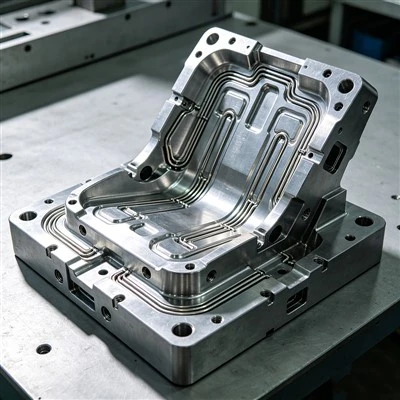


Our Car Engine Parts Mold is a custom aluminum die casting mold manufactured from H13 hot-work tool steel for producing automotive engine housings, valve covers, connecting brackets, and oil pans. We combine precision cavity machining, controlled cooling, and optimized metal flow design to support consistent casting quality in high-pressure, high-volume engine component production.
Technical Specifications
| Parameter | Specification |
|---|---|
| Mold Type | High Pressure Die Casting Mold |
| Mold Material | H13 Hot-Work Tool Steel |
| Heat Treatment | Vacuum Heat Treatment |
| Mold Hardness | HRC 50–54 |
| Machining Process | Five-Axis CNC + EDM |
| Applicable Casting Material | Aluminum Alloy |
| Gating System | Graded Pouring System |
| Cooling System | Full-Circulation Water Channels |
Engine Components
Engine Housings
Mold structures are designed around housing cavities, mounting points, and wall sections to support dimensional consistency and assembly requirements.
Valve Covers
We accommodate complex exterior profiles, sealing surfaces, and mounting features required for engine cover production.
Connecting Brackets
Cavity layouts are developed to reproduce mounting holes, reinforcement ribs, and connecting interfaces.
Oil Pans
We design tooling around the component's overall geometry, wall thickness distribution, and mounting structure.


H13 Steel & Thermal Stability
Forged H13 Tool Steel
We use H13 hot-work steel for its resistance to elevated temperatures, thermal fatigue, and molten aluminum erosion during repeated casting cycles.
Vacuum Heat Treatment
Our heat treatment process brings the mold steel to HRC 50–54, providing the hardness and wear resistance required for demanding die casting conditions.
Reinforced Mold Frame
We incorporate a reinforced frame and anti-deformation locking structure to maintain mold alignment under high clamping loads.
Cavity Machining
Five-Axis CNC Rough Machining
We process complex mold surfaces and cavity profiles to establish the required geometry.
Deep-Cavity EDM Finishing
Electrical discharge machining handles intricate cavity details and areas that are difficult to reach through conventional cutting.
Mounting Feature Control
We pay particular attention to critical cavity dimensions, hole positions, and mating surfaces that influence the dimensional consistency of finished engine components.
Gating, Cooling and Venting Design
Graded Pouring System
We configure the gating layout according to component geometry to promote controlled molten aluminum filling and reduce flow-related casting defects.
Circulating Cooling Channels
Integrated water channels help regulate mold temperature and reduce localized overheating during continuous production.
Exhaust Groove Structure
We incorporate venting passages to facilitate gas evacuation during cavity filling, helping reduce porosity and incomplete filling risks.
Customization Options
Cavity Configuration
Single-cavity or multi-cavity molds.
Mold Dimensions
Customized length, width, height, and cavity dimensions.
Mold Structure
Core inserts, sliding cores, ejector systems, and parting line configurations.
Gating System
Customized sprue, runner, and gate layouts.
Cooling System
Cooling channel layout and water connection configurations.
Venting System
Customized exhaust grooves and venting positions.
Machine Compatibility
Mold base dimensions, mounting interfaces, and clamping specifications.
Quality Control
Material & Hardness Testing
We verify H13 steel material certificates and use a Rockwell hardness tester to confirm the heat-treated hardness of HRC 50–54.
Cavity Dimensional Inspection
We use CMM measuring equipment to check cavity dimensions, hole positions, and critical geometric features against approved drawings.
Mold Assembly Inspection
We inspect mold alignment, parting surfaces, guide pins, sliders, and ejector mechanisms to verify proper fit and movement.
Trial Casting Verification
We inspect sample castings for dimensional deviations, surface defects, flash, and incomplete filling, with results compared against customer specifications.
Mold Maintenance, Repair and Upgrade
Our support continues beyond initial mold manufacturing and delivery.
Wear Component Maintenance
We provide maintenance for mold components subject to repeated thermal and mechanical loading.
Mold Repair
We support repair work when cavity wear, structural damage, or operating issues affect production.
Tooling Upgrades
We can modify existing mold structures to accommodate approved component design changes or updated production requirements.
Technical Support
We assist customers with mold-related technical issues during subsequent production and maintenance.
Information Required for a Mold Quotation
To evaluate your engine component tooling project, we review the following information:
3D CAD Files
STEP, IGES, or other commonly used 3D formats for cavity and mold structure assessment.
2D Engineering Drawings
Critical dimensions, tolerances, mounting interfaces, and technical requirements.
Casting Material
Aluminum alloy grade and any specified material requirements.
Production Requirements
Expected production volume, target machine specifications, and preferred cavity configuration.
Project Details
Required delivery schedule, trial casting expectations, and mold acceptance criteria.
Contact our engineering team with your engine component drawings for a customized mold proposal.
FAQ
What Is the Lead Time for an Automotive Engine Parts Mold?
Lead time varies with mold complexity and machining requirements. Our production schedule covers design confirmation, machining, assembly, and trial casting.
Can You Modify an Existing Engine Parts Mold?
Yes. We modify existing tooling to accommodate revised component dimensions, structural changes, and updated production requirements.
Who Owns the Custom Engine Parts Mold After Payment?
Mold ownership, usage rights, storage, and confidentiality terms can be clearly defined in the purchase agreement.
Can You Supply Spare Parts for Car Engine Die Casting Molds?
Yes. We supply replacement components such as core inserts, ejector pins, sliders, and other tooling parts based on original mold specifications.
How Are Engine Parts Molds Packaged for International Shipping?
We arrange protective treatment and export wooden crating according to mold dimensions, weight, and transportation requirements to prevent corrosion and handling damage.
Can You Handle Engineering Changes After Mold Design Approval?
Yes. We assess requested changes for their impact on mold structure, machining work, and production schedules before implementation.
Hot Tags: car engine parts mold, China car engine parts mold manufacturers, suppliers, factory, Auto Air Vent Mold, Car Air Outlet Mold, Car Engine Parts Mold, Car Seat Component Mold, Car Transmission Case Tooling, Car Vent Component Mold