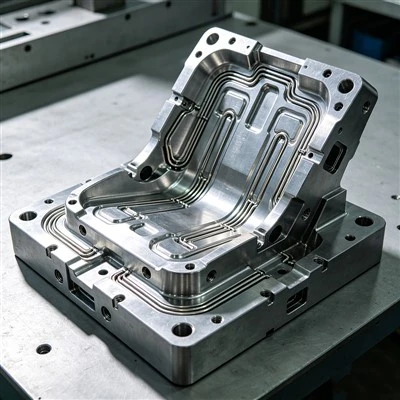


Our Car Transmission Housing Mold is a custom aluminum high-pressure die casting mold designed for manufacturing automotive gearbox housings, clutch housings, and transmission protective casings. Built with forged H13 hot-work tool steel, it combines precision cavity machining, reinforced mold construction, and integrated cooling and exhaust systems to support repeatable production of complex transmission components for passenger cars, electric vehicles, and commercial vehicles.
Technical Specifications
| Parameter | Specification |
|---|---|
| Mold Type | Aluminum High-Pressure Die Casting Mold |
| Mold Material | Forged H13 Hot-Work Tool Steel |
| Heat Treatment | Vacuum Heat Treatment and Tempering |
| Mold Hardness | HRC 50–54 |
| Machining Process | Five-Axis CNC Machining, Deep-Cavity EDM |
| Gating System | Graded Pressurized Pouring System |
| Cooling System | Circulating Cooling Waterways |
| Exhaust System | Multi-Group Exhaust Grooves |
| Mold Structure | Reinforced Mold Base, Double Locking Structure |
| Customization | Multi-Cavity, Size and Structural Customization |
| Quality Verification | Dimensional Inspection and Sample Trial |
H13 Steel & Heat Treatment
We use forged H13 hot-work tool steel to withstand the repeated thermal and mechanical stresses of high-pressure aluminum die casting.
HRC50–54 Hardness: Vacuum heat treatment and tempering bring the mold steel to HRC50–54, providing the hardness and toughness required for repeated casting cycles.
Thermal Fatigue Resistance: H13 steel offers resistance to thermal cracking and repeated temperature fluctuations during molten aluminum contact.
Erosion Resistance: The hot-work steel structure helps withstand repeated molten metal impact and wear in high-pressure casting operations.
Cavity Machining
Complex transmission housings require accurate cavity profiles and internal forming structures. We combine five-axis CNC machining with deep-cavity EDM finishing to manufacture critical mold features.
Complex Cavity Machining: Five-axis machining handles multi-angle surfaces and intricate cavity geometries, reducing setup-related positioning deviations.
Deep-Cavity Finishing: EDM processes machine deep grooves, narrow features, and complex internal contours that are difficult to access with conventional cutting tools.
Assembly Accuracy: Precision machining of mating surfaces and positioning features supports consistent mold alignment and component fit.
Gating, Cooling & Venting System
Our mold integrates optimized gating, exhaust, and circulating cooling systems to control molten aluminum filling, air evacuation, and heat distribution during high-pressure die casting.
Graded Gating Design: The staged pouring arrangement controls molten aluminum entry and distribution across different cavity sections, supporting balanced filling.
Multi-Group Exhaust Grooves: Distributed exhaust channels help release trapped air during filling, reducing the risk of gas porosity and incomplete casting.
Circulating Cooling Waterways: Strategically arranged cooling channels remove heat from critical cavity areas and reduce localized temperature buildup.
Thermal Balance: Coordinated cooling and venting configurations help maintain stable mold conditions and improve casting consistency during repeated production cycles.
Customization Options
We customize transmission housing molds according to customer drawings, casting materials, production requirements, and die casting machine specifications.
| Customization Item | Available Options |
|---|---|
| Mold Material | H13, Other Hot-Work Tool Steels |
| Casting Alloy | ADC12, A380, Other Aluminum Alloys |
| Cavity Configuration | Single-Cavity, Multi-Cavity |
| Mold Structure | Core, Slider, Side-Pull Mechanisms |
| Gating System | Customized Gate and Runner Layout |
| Cooling System | Cooling Channel Layout |
| Mold Dimensions | Based on Part Drawings |
| Surface Treatment | Customized as Required |
Dimensional Inspection
We apply precision measuring equipment and trial casting verification to check mold dimensions, assembly accuracy, and initial casting performance before delivery.
CMM Dimensional Testing: We use coordinate measuring machines (CMM) to inspect critical cavity dimensions, positioning points, and mating surfaces against approved CAD data, identifying dimensional deviations before mold acceptance.
Hardness Testing: We use hardness testers to verify the heat-treated H13 mold steel reaches the specified HRC 50–54 range, ensuring compliance with the agreed material requirements.
Trial Casting Inspection: We examine T1 samples for filling defects, surface quality, and critical dimensions to identify potential issues such as porosity, flash, and incomplete filling.
Mold Fitting Verification: We check mold alignment, locking mechanisms, slider movement, and ejection operation to confirm proper assembly and mechanical function before shipment.
Mold Maintenance & After-Sales Support
We provide ongoing tooling support to help customers maintain mold condition throughout its service life.
Mold Repair: We provide repair services for worn or damaged mold sections to restore their working condition.
Cavity Polishing: We perform cavity surface polishing to address wear and maintain the required surface condition.
Mold Modification: We support structural modifications when component designs or production requirements change.
Long-Term Tooling Support: Our mold repair and maintenance services help customers manage tooling wear and reduce production interruptions.
FAQ
What Information Is Required for a Car Transmission Housing Mold Quotation?
We need 2D drawings, 3D CAD files, aluminum alloy specifications, annual production volume, and die casting machine details to prepare a tooling quotation.
Can You Manufacture EV Transmission Housing Molds?
Yes. We develop custom molds for electric vehicle gearbox housings and integrated transmission casings based on component geometry and production requirements.
How Do You Select the Suitable Die Casting Machine?
We evaluate projected casting area, injection pressure, mold dimensions, clamping force, and machine platen capacity to ensure equipment compatibility.
What Is the Lead Time for a Custom Transmission Housing Mold?
Lead time depends on mold size, structural complexity, machining requirements, and trial schedules. We arrange production timelines covering design approval, manufacturing, assembly, and testing.
Can You Manufacture Replacement Transmission Housing Molds?
Yes. We develop replacement tooling using existing mold drawings, 3D CAD files, or physical samples, considering the original machine interface and production requirements.
What Is the Expected Service Life of a Transmission Housing Mold?
Service life depends on casting alloy, operating temperature, production cycles, and maintenance conditions. We evaluate these factors when planning tooling life.
Hot Tags: car transmission housing mold, China car transmission housing mold manufacturers, suppliers, factory, Auto Emblem Casting Mold, Auto Engine Component Mold, Automotive Seat Hardware Mold, Car Logo Mold, Car Seat Component Mold, Vehicle Instrument Support Tooling